My Ghosts
Brigitte and Pascal are the proud owners of a 17th-century château where peacocks and conversation roam freely. Brigitte manages the bed and breakfast, and Pascal dedicates a tiny portion of his hyperactive days to his work as a drywall installer. I dread the heat, and the FIAC heat had already exhausted me, as a visitor, on several occasions during previous editions. Being an active participant, behind these thick walls and beneath these two-hundred-year-old trees, was therefore all the more enjoyable. A drywall installer is always welcome, especially in contemporary art, even more so when working with light, so being hosted by a château-owner who also happens to be a drywall installer was perfect.
loglo( rr )
logo( rr ) was therefore installed on a placo support in the reception room, which had been divided in two for the occasion by a placo partition and whose French doors were covered with plasterboard panels to create darkness.
Visitors entered in small groups after spending a few minutes in an anteroom to prepare them for the dimness and coolness of the exhibition space.
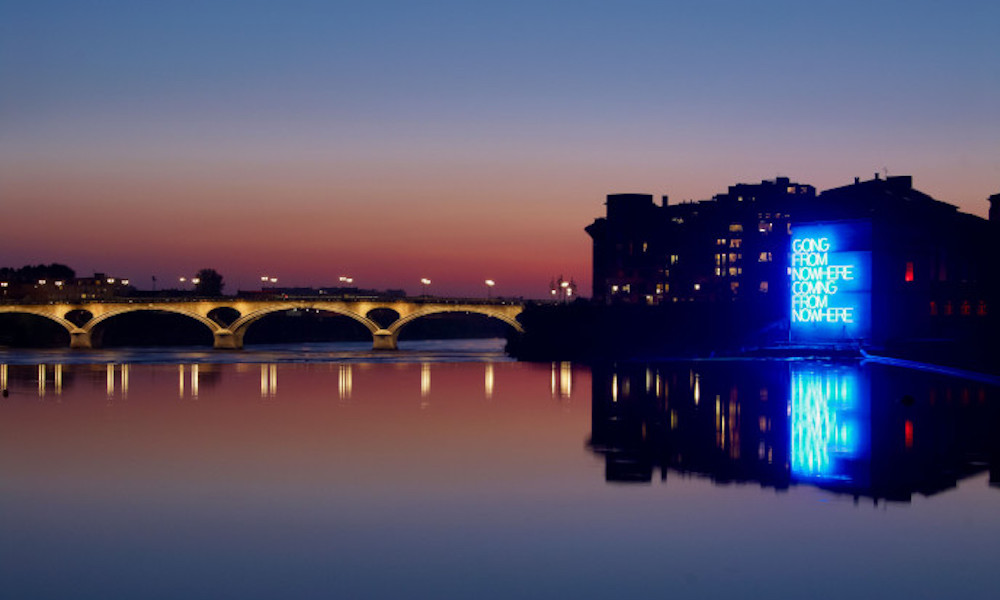
loglo( rr ) consisted of two symmetrical, interlocking neon lights. These two fragments of letters (in this case, two parts of the letter ‘r’) came from Mario Nanucchi’s work displayed on the facade of the EDF Bazacle hydroelectric plant in Toulouse during the Printemps de Septembre festival in 2009. All the other elements of this installation, which radiated “coming from nowhere, going from nowhere,” had been destroyed on-site during dismantling, and nothing else could be spared. A few months later, from January 7 to March 21, 2010, rollin’ (what goes up must come down) took on a rotating form on the same facade of this building on the banks of the Garonne. Since the Printemps de Septembre festival mainly takes place in October, coming from nowhere had preceded this project by a few months, although it had been initiated earlier. Like the Pont des Catalans, located within the Bazacle’s field of vision, coming consumed 10 kWh. For rollin’, which consumed 300 Wh, the bridge was switched off.
Like Antoine Perrot, who also created a neon work, a work made of… neon, I could say: I didn’t make my work out of neon.
As a former lighting designer, accustomed to concealing these light sources, I had previously been forbidden from using this material… by a ‘preservative’ choice, due to its incompatibility with the phenomenological environments I wanted to create, because of the material’s fragility and unpredictable gradation, influenced by kinetic art and ‘light and space’ artists, and by a rejection of a certain neon-like simplicity.
This antithesis, therefore, reflected a choice, involving, among other things, recycling. This electro blue, this ultramarine of the Costa del Sol, this Kersalé blue, so often used for signs and architectural highlighting… was not one of them. Loglo(rr) resembled a twin amalgam, a sign, a brand symbol, a playground, a map of the castle (according to visitor feedback)… but, more than the form, the electrical and cognitive phenomena were at work. Unlike most of my kinetic creations, randomness was introduced not by computer code, but by the material’s reactions at certain intensities and by the viewer’s perceptual and sensory state.
The neon’s significant power consumption was reduced tenfold thanks to appropriate two-phase programming. A period of long periods of very low-intensity lighting created random luminous vibrations of the trapped gases, which expanded and contracted within the glass—simultaneously electrified ether and trapped ectoplasm. The other phase, repeated several times, interspersed brief, intense flashes of light (1 second) with periods of darkness (10 seconds), leaving visitors facing the successive superimpositions created by their retinal persistence. The static phosphorescent afterglow of the switched-off neon light added to and blended with these fantastical perceptions, each with its own unique movements and cognitive agility.
I’m being a bit simplistic; I’m answering literally. To sum up, loglo (rr) was the ghost of a work that allowed everyone to experience their own inner ghosts.