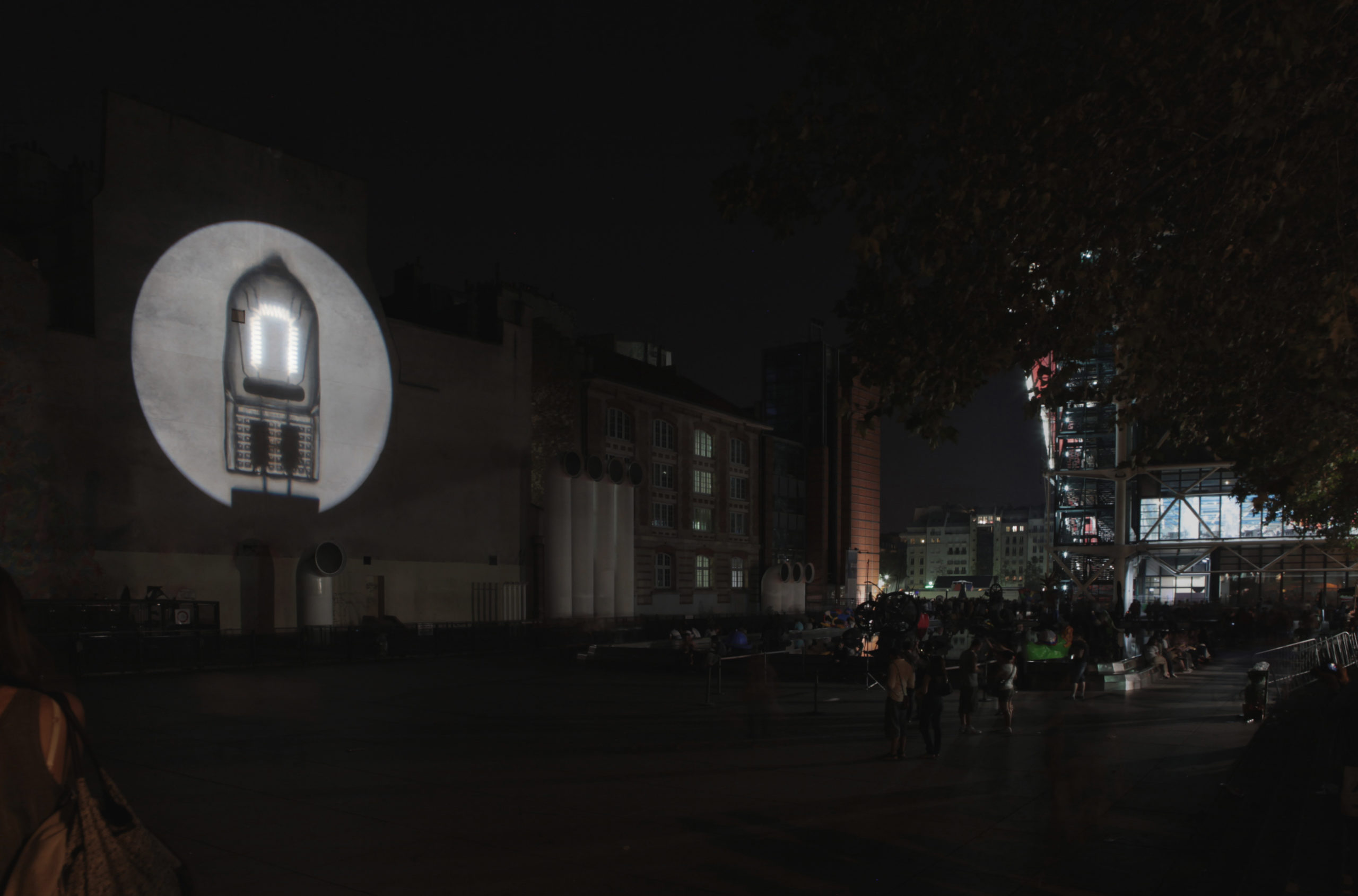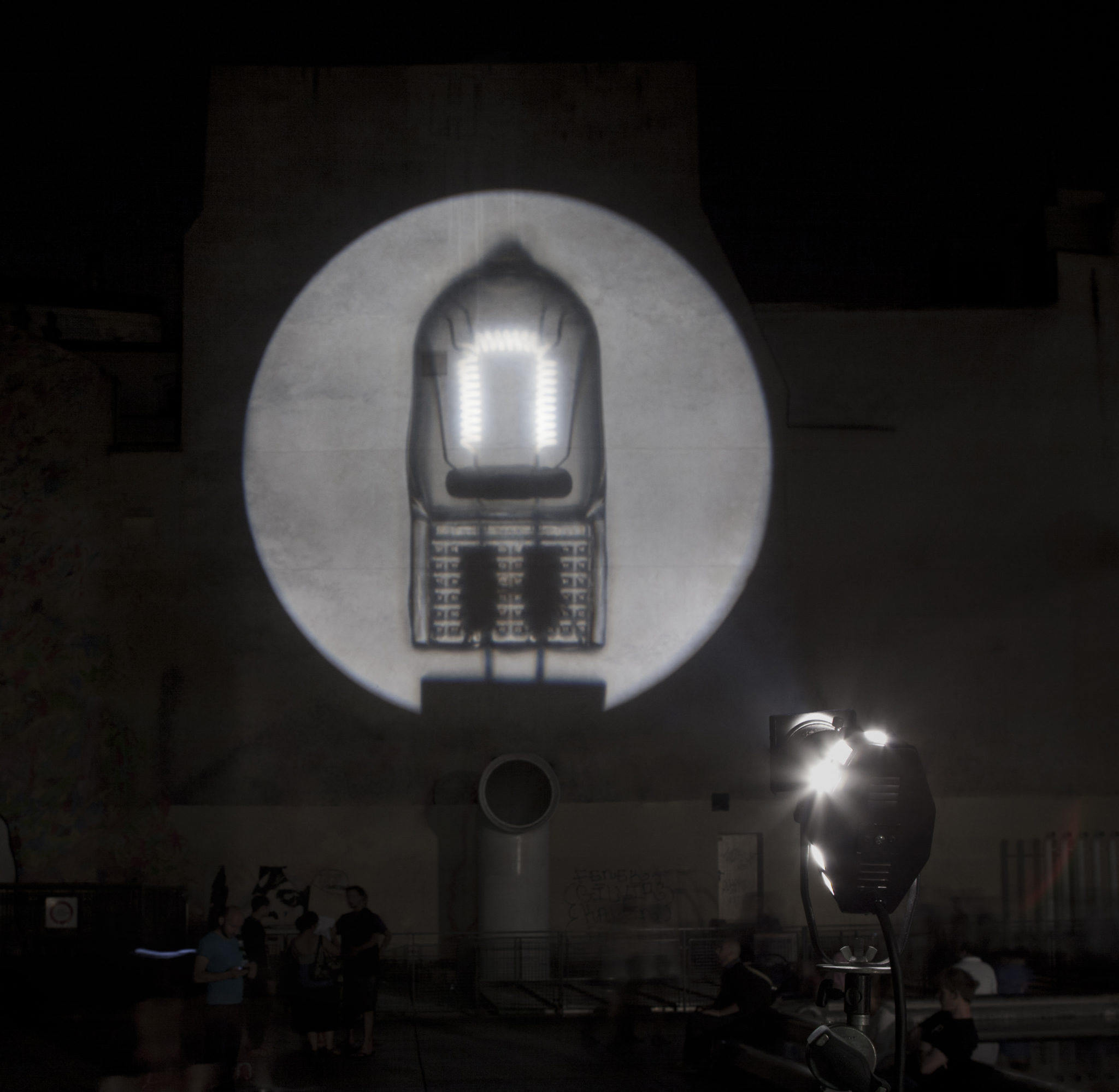
A modified theater projector is adjusted so that the light intensity produced by the lamp constitutes the source that diffuses its own image. The bulb projects light, which in turn projects itself. This mise en abyme is the result of a process of outline, an optical subtraction of obscuring influences. The corpuscular presence of the lamp, usually blurred, is revealed here. Through this process of stripping away, this highlighting goes against the usual function of the projector, which is to produce the most homogeneous beam possible; all ‘aberrations’ circumscribed. Yet everything is visible. The lamp, literally upside down within the body of the projector, focuses on itself and, through a mechanism of perspective reversal, imposes its self-affirmation. The phenomenon is made possible by the reflecting mirror, which, by inverting the image of this narcissus, acts as a tool for this personification. It thus reflects back to him his own presence while simultaneously activating his emancipation through projection. Thus, unlike a camera obscura that is univocal in its capture of the world, the projector acts as an inverted camera obscura, consequently introspective and then prospective.
The lamp surgically decomposes through its light: the lamp’s skeleton, its outline, its filament(s), its pins; as well as its internal metal base and socket, depending on the settings. A figure of a surface, a volume, but also a substance, the image presents itself to our perception. Its specular prominence then crystallizes the unreal. The weightlessness and spectral transparency of the lamp reiterate an ephemeral quality, suspending perpetual time. Tangible and ethereal at once, this ambivalent image revives impressions akin to the ghostly vision of photographic or radiographic negatives. In relief, beneath the lamp’s self-projection, another specular self-portrait is sedimented, reducing the human to the organic through clinical and anatomical references. The lamp used for the Nuit Blanche in Paris in 2011 takes the theoretical form of the colon, an inverted U (again), as it is represented in medical textbooks. To intertwine aspirations and means, LEDs are the primary light source for my interventions. However, the series of self-portraits, begun in 2002, cannot be conceived without the use of halogen lamps due to their ‘anatomical’ structure and symbolic weight.
Standardized in production, each lamp differs from the previous one due to numerous manufacturing variations. They thus acquire a particularity and uniqueness that are more easily revealed by the change in scale. The fact that a 500-watt, 10-cm-high lamp can assume a few meters of superficiality once self-projected alludes to the notion of vanity outlined above, especially since the lamps used for this project have an average lifespan of only a few hours. This intention is reinforced by the energy obsolescence of this technology, directly derived from Edison and now incompatible with the crucial requirements of environmental efficiency. Their aesthetic quality, both material and immaterial, gives the installation a museum-like quality, a contrast to a disappearance that we must paradoxically hope is imminent, and fuels the installation with a nostalgia through anticipation… through projection.
Gilles Conan – 2011